| | Hello ESTers!
Welcome back to InsideMENA, your bi-monthly snapshot of the key political, social, and cultural developments shaping the Middle East and North Africa, with an eye on Europe and the wider world.
As always, we’re bringing you concise analysis and fresh perspectives from across the region.
Ready to dive in? Let’s go InsideMENA!
P.S. Reading this on our website? Subscribe to get InsideMENA straight to your inbox every fortnight.
Edited by Clarice Agostini and Jesse Woche Note that the information, views and opinions set out in the newsletter are those of the authors and do not necessarily reflect the opinion or position of the editors, of the European Student ThinkTank, and of their affiliated entities or institutions.
|
|
North Africa Named the Continent’s Most Industrialised Region By Laura
|
|
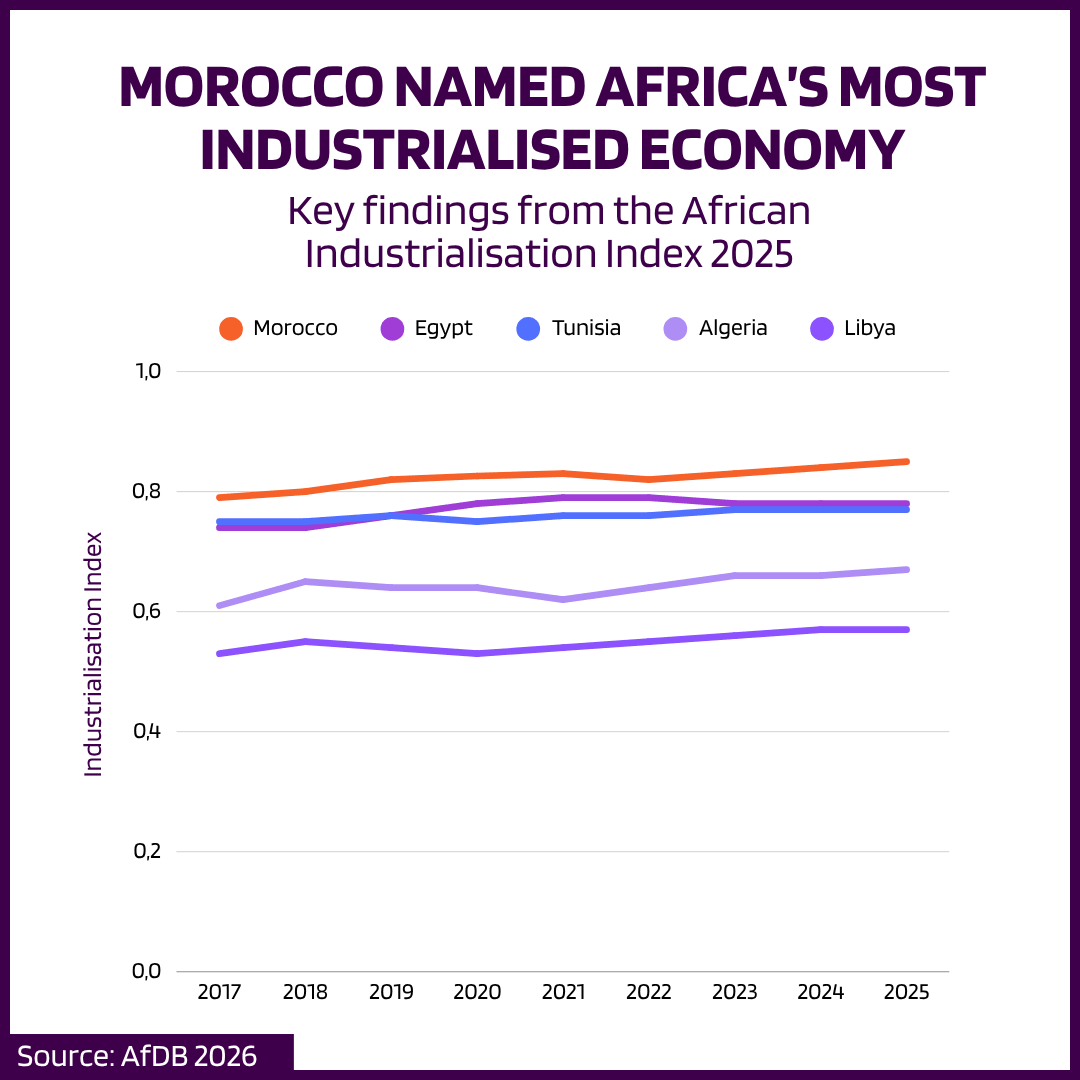
New report released. On May 26th, the African Development Bank released its 2025 African Industrialisation Index Report. North Africa remains the continent’s most industrialised region, with Morocco, Egypt, Tunisia and Algeria standing among the six largest industrial economies.
Morocco at the top. In the 2025 classification, Morocco tops the ranking as the continent’s leading industrial economy for the first time, surpassing South Africa, which has held the top position since 2010. This shift, however, is not a coincidence. Morocco’s economy is benefiting from decades of deliberate industrial policy structural transformation. Export diversification, a strategic investment in infrastructure, and the promotion of high-value manufacturing have been key for the country’s industrial modernisation.
Uneven progress. As the AfDB states, industrialisation remains Africa’s most credible avenue for achieving long-term prosperity and economic resilience. However, the 2025 report concludes that the continent’s industrialisation remains low and unevenly distributed. Fragmented markets and low regional integration are highlighted as some of the root causes.
Tunisia’s initiative. In April, Tunisia launched a new land trade corridor initiative aimed at connecting North Africa with the Sahel region. The project highlights the importance of stronger regional integration in overcoming trade barriers within the continent. However, due to the region’s political instability, infrastructural gaps, and security issues, it remains uncertain whether this ambitious project will be fully undertaken. |
|
Senegal's Political Earthquake: Sonko Fired, Then Elected to Lead Parliament By Romane |
|
From duo to rupture. After Sonko, Senegalese politician and former tax official, was disqualified from the 2024 presidential race, he threw his full support behind Senegal’s current President, Faye, under the slogan "Diomaye mooy Sonko" — "Diomaye is Sonko." Faye won decisively and appointed Sonko Prime Minister. Less than two years later, that alliance has collapsed.
The breaking point: debt and the IMF. The pair disagreed over public debt that the IMF estimates reached 132% of the country’s GDP, after the government disclosed previously unreported debts worth around $13 billion, prompting the IMF to suspend a $1.8 billion loan facility. Sonko opposed any restructuring and rejected requests to raise fuel prices.
The dismissal and comeback. On May 22nd, a presidential decree dissolved the entire government. Rather than retreat, Sonko moved swiftly. Four days later, the National Assembly elected him speaker with 132 votes, with no members voting against and one abstaining — the opposition having boycotted the session.
What's at stake. As head of PASTEF and now speaker, Sonko holds an ideal vantage point from which to challenge Faye's authority. An electoral code reform already clears his path to run for president in 2029. |
|
Main Opposition Leader Özgür Özel Ousted by Court Ruling in Türkiye By Isabella |
|
Court ruling. A court ruling on May 21st by the 36th Ankara regional court of appeal removed Özgür Özel as head of the main opposition party, the CHP. The court decided that Özel be removed and the former party leader Kemal Kılıçdaroğlu be reinstated. Özel and a major part of the party members have rejected the ruling, calling it another move in Erdoğan’s crackdown on democracy.
Violence erupts. The Turkish riot police were dispatched to remove Özel from the party headquarters in Ankara upon Özel’s vow to defy the court decision. The building was blocked off with barricades set up by party members in protest of the court decision. The siege, which started on May 24th, ended violently on May 25th with the riot police deploying tear gas, water cannons, and rubber bullets.
Özel continues to reject the ruling. As Kılıçdaroğlu’s team took over the building, Özel and many party members marched to the Parliament, declaring it “the official party headquarters.” The court decision had already sparked a wave of protests across the country and the violent ousting has only intensified them . Özel remains in parliament as the delegate of the opposition party representing Manisa. He also organised a rally in his home city in protest of the decision.
|
|
No War, No Peace in the Persian Gulf By A Voice from Iran |
|
Tension without open war. The Gulf is still in a dangerous “no war, no peace” situation after Iran’s attack on Kuwait and the U.S. strike on Qeshm. Both countries have used military force, but neither side seems ready to start a wider regional war.
Talks remain uncertain. The negotiation process is still unclear. Repeated attacks and low trust have made progress difficult. Trump has told his critics to “sit back and relax” while Tehran is seeking a deal with the U.S. At the same time, Iran’s Foreign Ministry says there are no nuclear talks currently happening with Washington. Diplomacy is not over, but it is taking place under strong military pressure and deep distrust.
Hormuz closure continues. Iran’s continued closure of the Strait of Hormuz, together with the U.S. naval blockade, have raised serious concerns about energy security, shipping routes, and regional stability. Mohammad Bagher Ghalibaf, Iran’s Parliament Speaker and lead negotiator, has accused the U.S. of breaking the ceasefire by continuing its blockade of Iranian ports. Meanwhile, the U.S. is helping tankers and ships avoid the closure amid Iranian threats.
Uncertainty ahead. For now, the region remains between conflict and diplomacy, with neither full war nor real peace in place. |
|
EU Council Restores Full Application of EU-Syria Cooperation Agreement By Francesco |
|
Council decision. The EU Council adopted a decision on May 11th terminating the partial suspension of the Cooperation Agreement between the European Economic Community and the Syrian Arab Republic, reinstating its full application. The decision repeals Council Decision 2011/523/EU that introduced the suspension in response to serious human rights violations by Bashar al-Assad’s regime. With the fall of the Assad regime in December 2024 and sanctions lifted in May 2025, the Council confirmed the conditions justifying suspension no longer exist.
Agreement reinstated. The reinstatement marks a major step toward strengthened bilateral relations and enables the EU-Syria High Level Political Dialogue to proceed as planned on May 11, 2026. The agreement, in place since 1978, abolishes customs duties on most Syrian industrial products imported into the EU and prevents quantitative restrictions on both sides. The partially suspended provisions covered trade in oil, petroleum products, gold, precious metals, and diamonds.
EU commitment continues. The European Commission will notify the Syrian Transitional Authorities, and the reinstated provisions become applicable from the first day of the first month following notification. This move follows Commission President Ursula von der Leyen’s January 2026 visit to Damascus, where she announced a €620 million financial support package for 2026–2027 covering humanitarian aid and early recovery. The decision sends a clear political signal of the EU’s commitment to re-engage with Syria and support its socio-economic recovery. |
|
|
| |
| |
|