| Hello ESTers!
Welcome back to InsideMENA, your bi-monthly snapshot of the key political, social, and cultural developments shaping the Middle East and North Africa, with an eye on Europe and the wider world.
As always, we’re bringing you concise analysis and fresh perspectives from across the region, along with InsideCulture, our dedicated space for music, film, writing, and digital voices that spotlight the stories and creativity shaping everyday life across the MENA region.
We at the Observatory continue to wish a blessed Ramadan to all who observe, and hope this period brings relief, reflection, and peace.
For those who don't celebrate, we hope this edition brings you closer to the MENA region during these extraordinary times.
Ready to dive in? Let’s go InsideMENA!
P.S. Reading this on our website? Subscribe to get InsideMENA straight to your inbox every fortnight.
Edited by Clarice Agostini and Jesse Woche Note that the information, views and opinions set out in the newsletter are those of the authors and do not necessarily reflect the opinion or position of the editors, of the European Student ThinkTank, and of their affiliated-entities or institutions.
|
|
Iran Under Fire: Losses and Destruction After the Strikes By Mohammad
|
|
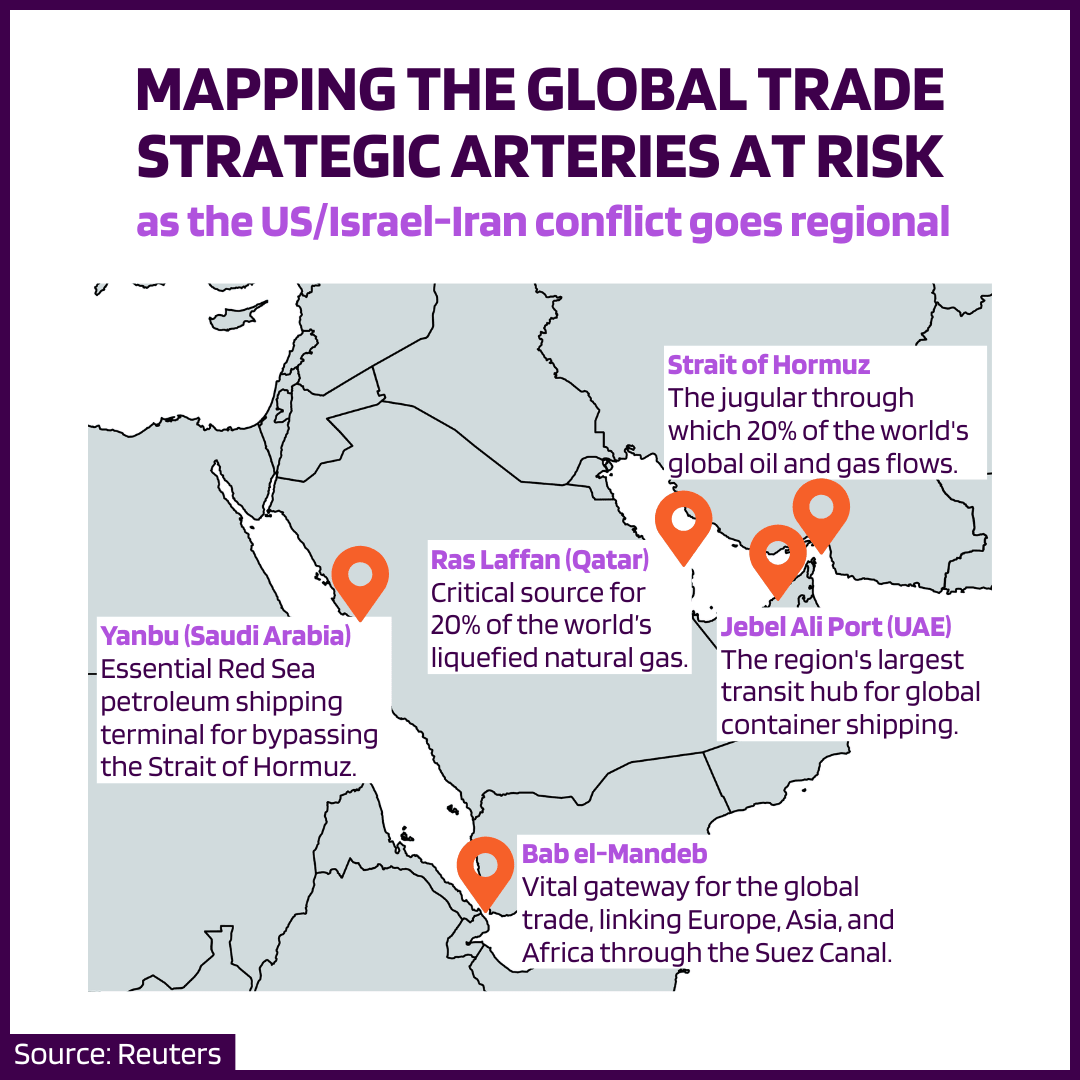
Situation update. On 28 February and again on 1 March, the United States and Israel carried out “preemptive” air and missile strikes across Iran, hitting command sites, air defence, and nuclear-linked facilities. The operation triggered regional alarm, with flights disrupted and markets reacting to the risk around the Strait of Hormuz. Consequently, the UN held an emergency meeting, “calling for de-escalation and an immediate cessation of hostilities.”
Leadership losses. Supreme Leader Ayatollah Ali Khamenei was killed by a joint Israel/U.S. strike during a meeting with his top security advisors in his Tehran compound. Several top government figures died, including Defence Minister Amir Nasirzadeh, IRGC Commander Mohammad Pakpour, Supreme Leader Senior Adviser and Secretary of Defence Council Ali Shamkhani, alongside other commanders and officials. Tehran has announced a mourning period, and an interim leadership process–a Leadership Council–has been formed.
Regional retaliation. Iran answered with missiles and drones not only toward Israel, but also toward Persian Gulf states hosting U.S. forces. Explosions and interceptions were reported across parts of the Persian Gulf region, including in Bahrain, the UAE, Qatar, and Kuwait, with some civilian damage reported. Governments in the Persian Gulf raised security levels while urging de-escalation, as ports and energy traders watched closely. |
|
Ankara Offers Mediation Amid Escalation in the Middle East By Isabella |
|
Ankara steps in. As tensions flare across the Middle East, Ankara is signaling it wants to play peacemaker. Speaking at an iftar event in Istanbul on February 28, President Recep Tayyip Erdoğan said Türkiye was “deeply concerned” about the latest round of violence, which he blamed on Israeli Prime Minister Netanyahu’s provocations. Warning that the region could be dragged into a wider “ring of fire,” Erdoğan stressed that diplomacy must take priority.
Calls flying, phones buzzing. Behind the scenes, Türkiye’s diplomatic traffic has picked up speed. Foreign Minister Hakan Fidan held phone calls with his counterparts from Iran, Iraq, Saudi Arabia, Qatar, the UAE, Syria, Egypt, and several European and Asian countries. According to the Foreign Ministry, the talks focused on how to stop the attacks and prevent further escalation. Ankara publicly condemned actions that violate international law and threaten civilians, while underlining that Türkiye is ready to offer mediation support.
EU coordination matters. Communication with Brussels followed soon after. Fidan first spoke with EU Foreign Policy Chief Kaja Kallas, where the two discussed possible steps to bring the attacks to an end and ease tensions. Erdoğan then held a phone call with European Commission President Ursula von der Leyen, stressing the importance of close Türkiye–EU coordination. For now, Ankara is betting that fast-moving diplomacy on all lines can help stop the crisis from spiraling further. |
|
Palestinian Journalists Beaten, Starved, or Raped in Israeli Prisons By Hannah |
|
Alarming new report. 59 Palestinian journalists detained in Israeli prisons since 7 October 2023 have reported being beaten, starved, and subjected to sexual violence, according to a new report by the Committee to Protect Journalists.
Inhumane acts. The committee reached its findings after reviewing testimonies, photographs, and medical records that it says document serious abuses committed by Israeli soldiers and prison guards against Palestinian journalists. 48 of the journalists were never charged with a crime and were held under Israel’s administrative detention system, a cruel procedure that allows individuals to be held without charge and can be renewed indefinitely.
Deliberately targeted. The report states that these abuses were allegedly carried out because of the detainees’ profession as journalists. Journalist Amin Barake said he was repeatedly threatened over his work with Al Jazeera. According to the committee, these cases are not isolated incidents but part of what it describes as a deliberate strategy to intimidate and silence those documenting events in Gaza.
A pattern of abuse. While the Israeli Prison Service and the Israel Defence Forces have rejected the allegations, rights groups note that this is not the first time Israeli authorities have faced accusations of serious human rights abuses within the prison system. Meaningful accountability and reform are required to address this widespread mistreatment of journalists and Palestinians more broadly.
|
|
In Tunisia, Former PM Sentenced to 24 Years in Prison By Laura |
|
24 years for a former PM. On Friday, 27 February, Ali Larayedh, former Tunisian Prime Minister (2013-2014), was sentenced to 24 years in prison over allegations of having facilitated the travel of Tunisian jihadists to conflict zones in Syria over the past decade. Other former officials were also convicted, with sentences that range from 3 to 24 years.
Claims of a political trial. Larayedh, who has been in prison since 2022, addressed the court, stating: "I am innocent. I am being subjected to injustice, abuse, and ingratitude.” His party, the Islamist opposition Ennahda, has strongly condemned the sentence, claiming that the case is “politically motivated.”
A leading exporter of foreign fighters. After the 2011 revolution that ousted President Zine El Abidine Ben Ali, Tunisia became one of the largest per capita contributors of foreign fighters to the conflicts in the Middle East. Estimates suggest that more than 5000 Tunisians left to fight with jihadist groups in Iraq, Syria, and Yemen, among other countries. As one of the key political forces of the post-revolution period in Tunisia, Ennahda has been accused by its secular rivals of facilitating the departure of these fighters–an accusation that the party has categorically denied. |
|
US Signals Strategic Return to the Sahel Through Health Diplomacy By Jordi |
|
US re-entry in the Sahel. The recent $147 million US health systems agreement in Burkina Faso marks more than development cooperation: it signals Washington’s recalibrated engagement in a region reshaped by military coups. After strained relations and troop withdrawals across parts of the Sahel, the United States appears to be pivoting from a security-dominant posture toward soft-power instruments such as public health, institutional capacity, and civilian partnerships.
Soft power reached a new level in the Sahel. Since the coups in Mali, Burkina Faso, and Niger, Western military influence has declined while alternative partnerships—particularly security-driven ties with Russia—have expanded. By shifting toward health diplomacy and development support, Washington may be reopening channels of dialogue without directly challenging junta-led authorities. Soft power provides political space where military cooperation has become diplomatically sensitive.
A Turning Point for Sahel negotiations. This shift could reshape negotiations within Sahel states, especially in Burkina Faso, where authorities seek diversified partnerships while consolidating domestic legitimacy. If health and development cooperation proves sustainable, they may serve as confidence-building tools, gradually rebalancing external influence. The Sahel’s geopolitical contest is evolving: influence may now be negotiated less through bases and battalions, and more through hospitals, governance reform, and public trust. |
|
|
| |
|
|